Merit, memory, and the paradox of the invisible champion
Stefano Ticci was born in Forte dei Marmi. He represented Italy in four Winter Olympic Games. In Lillehammer, in 1994, he won a bronze medal in the two man bobsleigh together with Günther Huber. Before that, he had been a sprinter, running the 100 metres in 10.5 seconds. Then Georg Werth noticed him and turned him into a brakeman, one of those athletes who push the bobsleigh at the start, a few seconds of maximal effort that determine the entire run.
I worked with him. Not on the tracks, but in the offices of a State Police precinct in Versilia. I know him as a colleague before knowing him as a champion. It is perhaps this everyday proximity that makes something more visible, something that from a distance might go unnoticed: the condition of someone who represented a country and discovers, decades later, that he no longer has any symbolic place within the system that once selected him.
In recent weeks, several Italian Winter Olympic medallists have publicly raised an issue: the difficulty of finding a role, even a merely ceremonial one, in initiatives connected to the Games that will be held in their own country. This is not a dispute about privileges. Privilege implies an unjustified advantage. Here the issue is different. It is not about obtaining something extra, but about discovering that even what once seemed symbolically assured no longer exists.
The question does not concern the decisions of an organizing committee. It concerns something more structural: the relationship between merit and memory in contemporary societies.
Modern sport has never been only about competition. It has been a device of representation. The athlete’s body did not compete only for itself, but for something larger: a nation, a territory, an institution that selected it, displayed it, invested it with meaning. That body was functional and visible, charged with a value that exceeded performance.
To understand what has been lost, it is useful to look back.
In ancient Olympia, the winner of the Games did not receive money. He received a crown of wild olive, the kotinos, cut from the sacred tree in the precinct of Zeus. He returned to his city and found something more enduring awaiting him: a statue. The body that had won was fixed in bronze or marble, placed in the agora or the sanctuary, inscribed into the symbolic order of the community.
That statue did not celebrate an exceptional moment. It stabilized a civic function over time. The athlete, even after he had stopped competing, remained visible. His disciplined, proportioned body, made public, continued to speak. There was no sharp separation between the “before” of glory and the “after” of irrelevance.
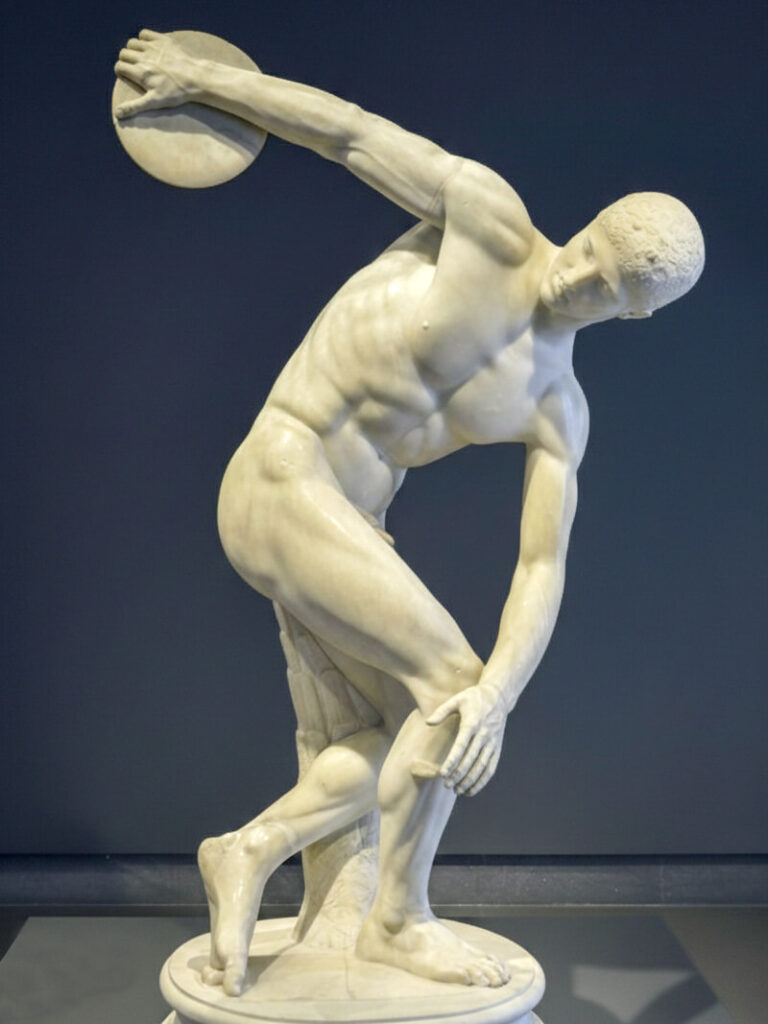
The Discobolus by Myron, the Apoxyomenos by Lysippos, the Boxer at Rest in the Museo delle Terme: these are not portraits of individuals, but archetypes. Forms that preserve the civic value of athletic commitment beyond the contingency of victory. The sculptor did not immortalize the winning gesture, but the enduring quality of those who had placed themselves at the service of sacred competition.
When Polykleitos codified the Canon, he was not describing an aesthetic ideal. He was fixing the proportions of the “exemplary citizen”: one who, through bodily discipline, had acquired the right to be remembered.
Things change. Contemporary systems operate through rapid erasure. The body that once represented is neutralized at the very moment it ceases to produce visibility. Merit does not sediment, it does not generate symbolic debt. It is consumed and archived. It leaves no statue, it leaves no trace.
In this sense, the champion who can no longer find a place is not an exception, but an emblematic case: a figure who represented the collective and who, once his visible function is exhausted, is treated like what remains after use, not like something to be preserved.
This logic governs many contemporary dynamics: the replaceable worker, the expert consulted once and then forgotten, the volunteer thanked in words and never contacted again. A form of structural ingratitude that does not arise from malice, but from an architecture that does not foresee memory as a function.
Public reactions to these situations intercept precisely this breaking point in the system. They do not merely defend individuals, but an implicit principle: the idea that service rendered to the collective should leave a recognizable trace over time.
When this trace disappears, what is produced is not only a perceived injustice, but an impoverishment of the civic pact. If merit is not even remembered, on what basis should it be invested in again? Why should a young athlete sacrifice years of his life to represent a country that will later archive him as a historical datum no longer open to interrogation?
In classical Greece, cities collected funds to finance their athletes’ participation in the Games. The victor’s return was a communal event. Sometimes a section of the city walls was demolished to let him enter: a symbolic gesture meaning “this is a solid and virtuous city, whose strength is manifested in its ability to form citizens who become champions”.
I am not asking for the walls of Forte dei Marmi to be torn down for Stefano Ticci, assuming it still makes sense today to speak of walls. I am not asking for anything, in fact. I am merely observing that the system that selected him, displayed him, and invested him with meaning no longer provides any form of symbolic continuity. And that this absence is not attributable to anyone in particular, but to the structure of the system itself. A structure that, precisely for this reason, clearly reveals a trait of contemporaneity: the difficulty of transforming merit into memory, and the extension of this logic to many other areas of civic life.

“The Boxer at Rest of the Baths is a statue from the late Hellenistic period. It depicts a seated athlete, his body marked by blows, his face weary. He is not winning. He is existing after the competition, after everything. And he is still there, visible, open to interrogation.”
This article was automatically translated from Italian. The original text reflects the author’s thoughts — please be
aware of potential linguistic differences in the translation.

The contents on this website are protected by a Creative Commons
license. 👈 Click on the image to learn more.