On Juggernaut, the dark fantasy by the Ricci brothers and Krilov, and on what remains once desire has been granted.
For more than two years, Juggernaut has been travelling through festivals across much of the world, where it has so far collected thirty-five awards and more than eighty international selections. It is a twenty-minute short film, born from the creative trio of Daniele Ricci, Emanuele Ricci, and Eugenio Krilov.
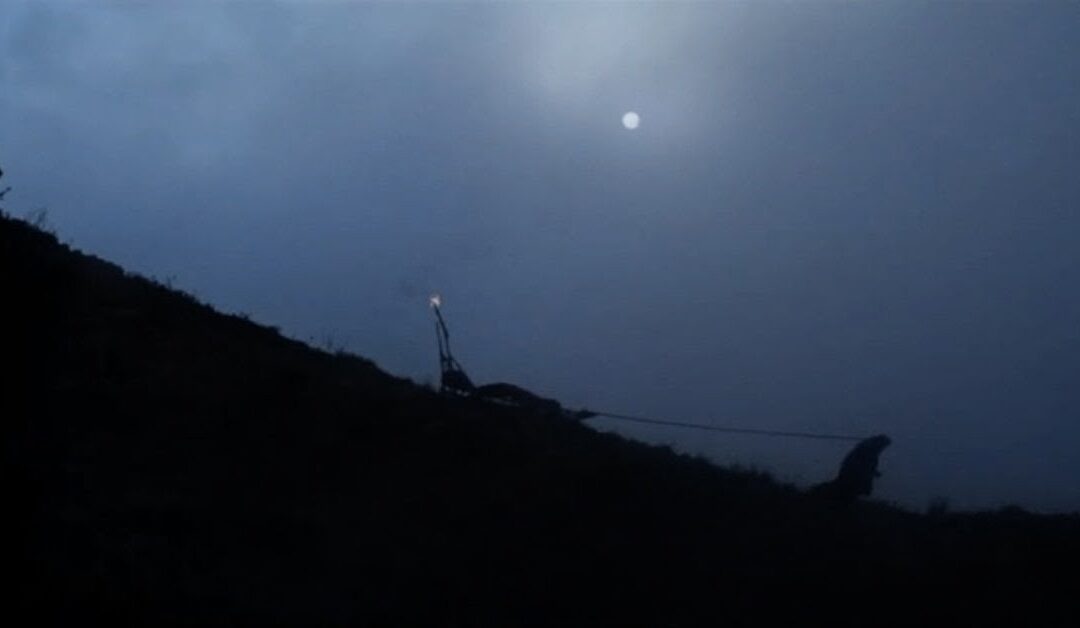
It begins with a man dragging a sled through a forest. On the sled there is something the camera never fully reveals, but whose presence is felt in the way the ground resists. The film begins from this friction and immediately takes a less familiar path: instead of using the fantastic as an escape route from the world, it burdens it with weight.
This is what strikes us even before the armour or the creature. Almost everything in the film seems to have to be carried: the body carries the iron, and the iron takes the body back, bends it, brings it to the ground. Armour, which in fantasy is a sign of power, here exposes the body rather than protecting it, and with every fall lays bare its fragility. What we are facing is a physical condition more than a repertoire of dark symbols.

The world does not surround the protagonist; it resists him: the ground holds the sled back, and every metre has to be torn from it. The sled is the centre of this resistance, because it carries what he cannot leave behind. The way he drags it is enough to tell us that something on that wood belongs to death.
Mourning is never named, and it could not be: the short film has no dialogue, sustained by sound design alone. No psychology, no explanations. What remains is a man who keeps walking when movement already resembles a sentence. Many fantastic narratives construct the journey as an initiatory trial: one sets out, faces the obstacle, and returns transformed. Here, the curve is different. The protagonist does not cross the threshold in order to overcome it… he forces it.

At this point it is worth invoking a form the film almost certainly did not have in mind, yet one that illuminates its structure. In the Galleria dell’Accademia in Florence stand Michelangelo’s Prigioni, the figures intended for the tomb of Julius II and left unfinished. They are bodies that emerge halfway from the block without breaking free of it. A shoulder, a torso come out of the stone; the rest remains inside the rough marble, which the figure continues to carry on itself like a burden. For centuries, critics have debated whether that unfinished state was intentional or imposed by circumstance: a tomb never completed, too many worksites open at once. But before those figures, the effect is stronger than the cause. They do not seem unfinished; they seem imprisoned, because they still carry on themselves the matter from which they come.
Juggernaut stands there. The man dragging the sled is a figure unable to separate himself from his own block. That weight resembles less an obstacle along the path than the part of himself that cannot be carved away, the rough matter still attached to the figure. Mourning, in these terms, is a non finito: it remains inside the material, and the body continues to carry it because detaching itself from it would mean admitting that it is over. And marble, as we know, does not let itself be carved wherever the sculptor wishes.
To make pain weigh rather than narrate it is a gamble, especially on a low budget, where the convenient path is always speech: dialogue costs little, explains everything, seals the gaps of a world that cannot be shown in full. Juggernaut does the opposite. It removes words and lets weight and image sustain the film.
The Italian landscape also enters this logic. Not as postcard, nor as a marker of identity. Fantasy that proclaims itself Italian simply because it was shot in Italy is a weak shortcut. Part of the film was shot among the Apuan Alps, the mountains of marble; what it takes from them is stone and hardness, not scenery. These are places I know, and anyone who knows them sees at once that this hardness is not a set effect. It is the true matter of the place. The film does not construct it; it finds it already there. The territory becomes matter to be deformed, a machine that generates form rather than a backdrop to be displayed.
What remains is the protagonist, who is not the vertical hero dominating space. He is a burdened figure, one who drags more than he fights, and drags himself in the process; his obstinacy cannot be read in one way alone. It holds together, without resolving them, two opposing movements: fidelity / blindness. The short film becomes adult precisely where it stops applauding willpower. To go on, here, is not automatically a virtue. It may be the way a man refuses to admit that something is over, a form of imprisonment that has learned to call itself fidelity.
Mourning and the desire to correct the irreparable are too dense a matter to be confronted head on without slipping into sentimentality; placed inside a form, they remain visible without needing to be explained. We watch it within a present made of rapid, polished images, designed to flow away without friction, consumed in the time it takes a thumb to slide across a screen. Juggernaut moves in the opposite direction: it slows down until the image becomes once again a thing that resists, something to be crossed rather than scrolled past. It is a deliberate slowness, holding the gaze where it would usually slip away.
In other narratives, the threshold between those who remain and those who are no longer there is a wall against which one learns the limit. Here, the wall gives way. Michelangelo had left his Prigioni in the block, suspended forever between stone and figure. Not this knight. He has wanted to tear his loss from the marble at any cost, and he succeeds. This is where the film turns black. Not in renunciation, but in what remains when the irreparable allows itself to be forced and desire is granted.
Sometimes, getting it back is the harshest sentence of all.
This article was automatically translated from Italian. The original text reflects the author’s thoughts – please be
aware of potential linguistic differences in the translation.
The contents on this website are protected by a Creative Commons
license. 👈 Click on the image to learn more.