Nilda Comas’s Sculpture and the Memory of San Mateo de Cangrejos
In the forecourt of the Del Chiaro foundry in Pietrasanta, Saint Matthew holds a crab above his head.
Nilda Comas’s bronze has not yet reached the place for which it was conceived. It will travel to Puerto Rico, where it is to be installed in the territory from which it takes its title: San Mateo de Cangrejos. For now, it stands before the parish priest, Don Roberto Canale; the mayor, Alberto Stefano Giovannetti; the invited guests; and a Puerto Rican delegation that includes Fernando Sumaza and Diana Sumaza, patrons of the sculpture, who have come to see it off.
The saint stands barefoot upon a bronze shore. The sand preserves footprints and shells; a crab emerges beside his feet; a scroll, accompanied by a quill and inkwell, bears two engraved names… and the reason there are two will become clear later. From that base, the body rises: a golden band bearing the name across the chest, arms extended above the head, the face tilted upwards. At the summit, held firmly between his hands, is the golden crab, catching the light.
The gesture recalls an ostension: something is removed from its ordinary condition and raised to the point of greatest visibility. What traditional iconography places in the evangelist’s hand, the written word, here lies at his feet, upon the sand. Above, the saint raises a crab.

To understand the gesture, it is worth recalling who Matthew was. The Gospel presents him seated at the tax booth at the moment of his calling. He collected tribute on behalf of the Roman occupiers, and his own people regarded him as someone to be kept at a distance, a collaborator. Among the Twelve, his is the story that begins within the contempt of others. And it is his Gospel that preserves the words read by the parish priest during the blessing, the Beatitudes: the poor in spirit, the meek, those who hunger for justice, the persecuted. Words that place at the centre those whom society keeps at its margins.
The sculpture enacts a movement of the same kind. The crab belongs to the shallows, the channels, the mangroves, to the daily catch of those who possess nothing else. In the work, it occupies the highest point, the position ordinarily reserved for a sacred attribute or an emblem of authority.
To understand what is being raised, we must return to the name of the place.
Cangrejos, “crabs”, was the name given by the Spanish as early as the sixteenth century to a crustacean-rich peninsula on the coast of Puerto Rico. The community that grew there did not originate in an act of foundation. It began with people: Black people who were already free, men and women who had been emancipated, and enslaved people who had escaped by sea from the Danish, English and Dutch colonies of the Caribbean. A Royal Decree issued in 1664 promised freedom, together with a small plot of land, to those arriving from territories controlled by Spain’s enemies.
This was not generosity. The Crown deprived its rivals of labour and, in return, acquired farmers and men to defend the fortified city of San Juan, while slavery remained legal under that same system. It was freedom granted out of self-interest. Yet for those who stepped ashore from those boats, it was real freedom, and Spain did not decide what they would make of it.
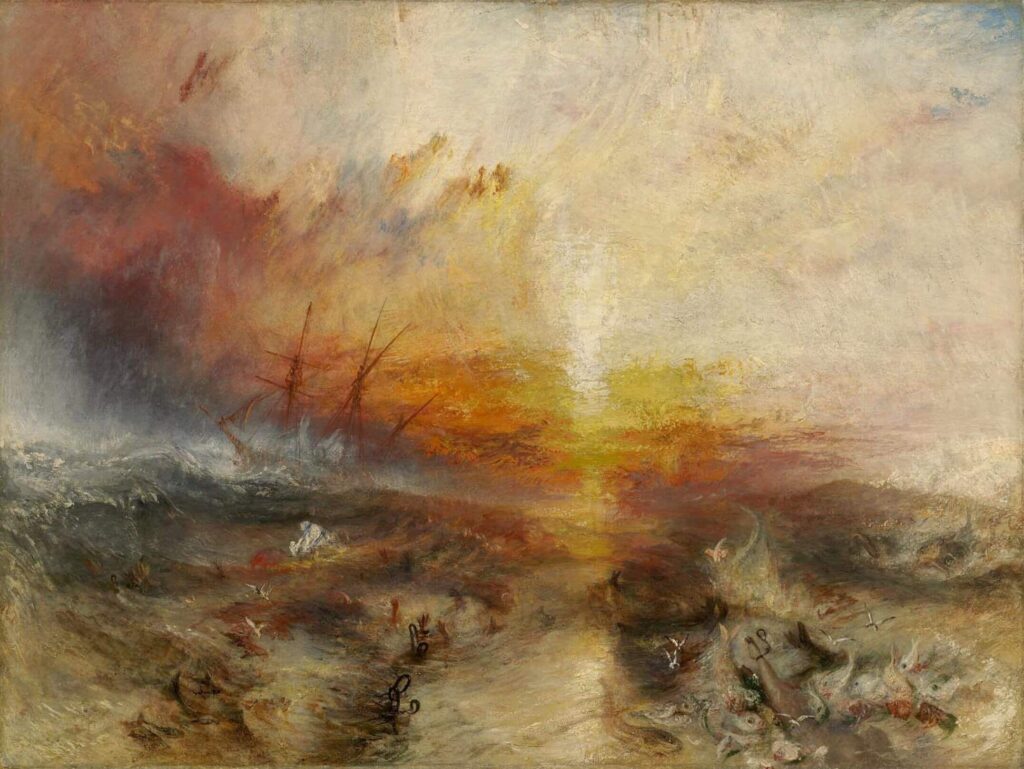
Art has often shown us the world from which they fled. Never, however, with the force of J. M. W. Turner’s Slave Ship, exhibited in 1840 and now held in Boston, which recalls the history of the slave ship Zong. In 1781, 133 enslaved Africans, some alive and others already dead, were thrown into the sea. The ensuing legal action was not a murder trial but an insurance dispute, because under the law of the time those people were considered cargo. The canvas is almost entirely storm and light; all that remains of the bodies are fragments in the foreground, hands and a shackled leg, which the water is swallowing before our eyes.
The sculpture in Pietrasanta, however, performs the opposite movement. Something is drawn out of the water and raised aloft. For the people of Cangrejos, the sea was not only the route of the slave trade; it was also the path by which freedom could be regained, while its shallow waters provided the means by which they survived. Crabs, fish, charcoal and rice travelled from the mangroves to the capital, which depended on that supposedly unhealthy periphery far more than it cared to admit.

That freedom, granted out of calculation, was patiently built into a life. The community established a place of worship, documented from at least 1729, together with militias of its own. In 1773 it became an autonomous municipality under the name of its patron saint: San Mateo de Cangrejos, the apostle and the crabs joined in a single name. When British troops landed in that same inlet in 1797, the defenders of San Juan included ninety-two militiamen from Cangrejos, free Black men defending a land that was finally their own.
Then history changed course. In 1862, a decree abolished the municipality and divided its territory; in 1880, the name Cangrejos was replaced by Santurce, derived from the noble title of a businessman of the period. We do not know whether anyone intended to erase a memory. We know that this was the effect, because those who pass through the district today may have no idea that beneath its present name lies the history of a village built by men and women who had escaped slavery.
It is in that district that the bronze will find its home. Commissioned by a private individual in Puerto Rico, it is destined for the public park leading to the Museo de Arte de Puerto Rico, in the heart of present-day Santurce. Of the intentions behind the commission, I know only what the ceremony allowed one to see: a delegation that had travelled this far to accompany a saint and a crab. Yet here, as with the name, the effect is what matters. The work returns Cangrejos to the very place from which it had disappeared. It does so through the hands of a sculptor born in San Juan, who pursued further training at the Academy of Fine Arts in Carrara and now works in Pietrasanta.
It is precisely at this point that Nilda Comas’s sculpture intervenes. On its own, it cannot recount the whole history. It needs words, documents and the memory of those who preserve it. Anyone unfamiliar with that history sees a saint raising a strange animal. But it is this very incongruity that brings the work to life: the crab compels us to ask why it is up there.
In this sense, the sculpture is a parable in bronze. Like a parable, it offers no ready-made moral; it brings two things into relation and leaves the viewer to recognise the connection. On one side stands the apostle who entered the company of the Twelve from the lowest point, from the tax collector’s booth and the contempt of his own people. On the other is the crab, preserving the name of a community admitted for reasons of imperial expediency by a power that had never abolished slavery, and which made a life of its own from that self-interested grant of freedom.
Read before the work, the Beatitudes cease to be a liturgical formula and become a proclamation once more: those at the bottom are not destined to remain there, and what lies below can support everything built upon it.
When the bronze reaches Puerto Rico, Saint Matthew will carry with him the name of a territory and the memory of a community that fashioned a free life from a calculated concession.
This article was automatically translated from Italian. The original text reflects the author’s thoughts – please be
aware of potential linguistic differences in the translation.

The contents on this website are protected by a Creative Commons
license. 👈 Click on the image to learn more.