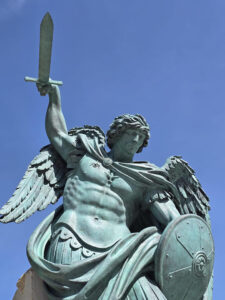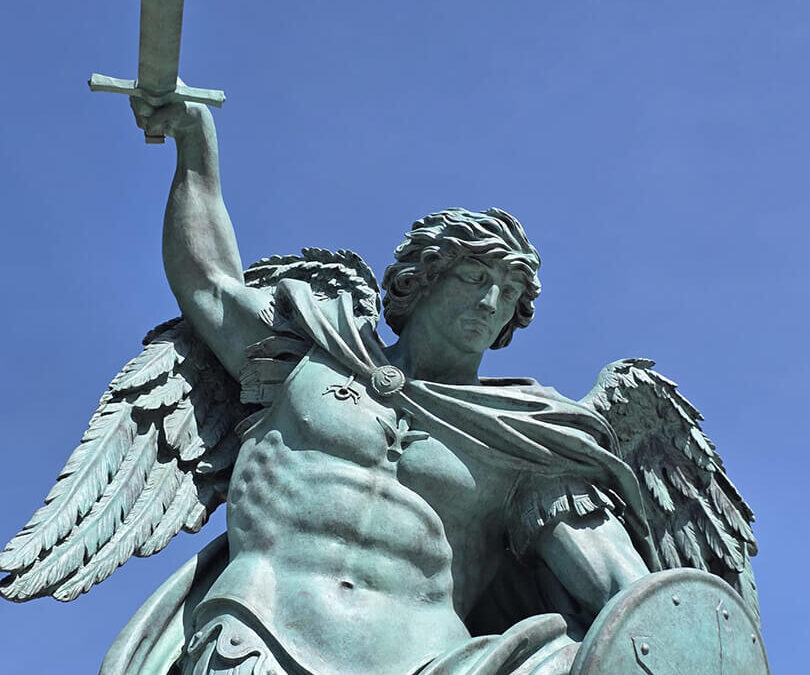
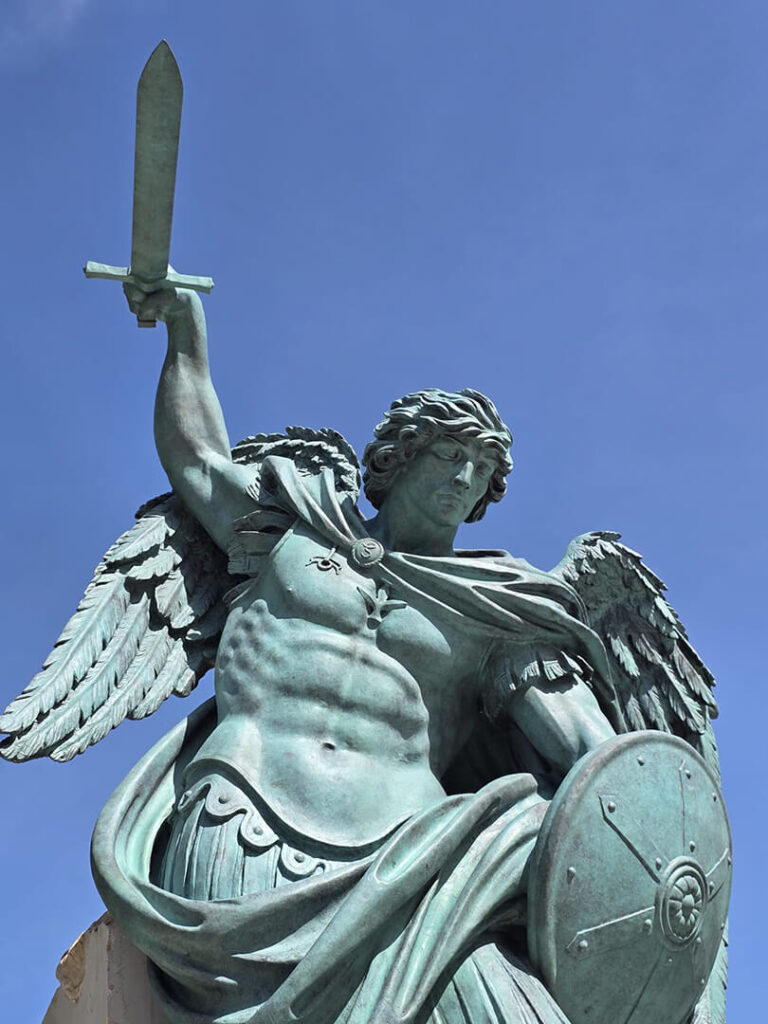
Sergey Eylanbekov’s Saint Michael the Archangel, a plaster model donated to the Lucca Police Headquarters.
A classical lesson in restraint, seen up close.
I first saw Sergey Eylanbekov’s Saint Michael in its earliest form: a plaster model just over a metre high, before bronze, before monumental scale, still marked by the traces of its making. In sculpture, this is a decisive stage: the idea has already acquired a body and has begun to hold its own in space. From this point on, one is no longer judging a project alone, but a form, with its weight, its balance and its proportions.
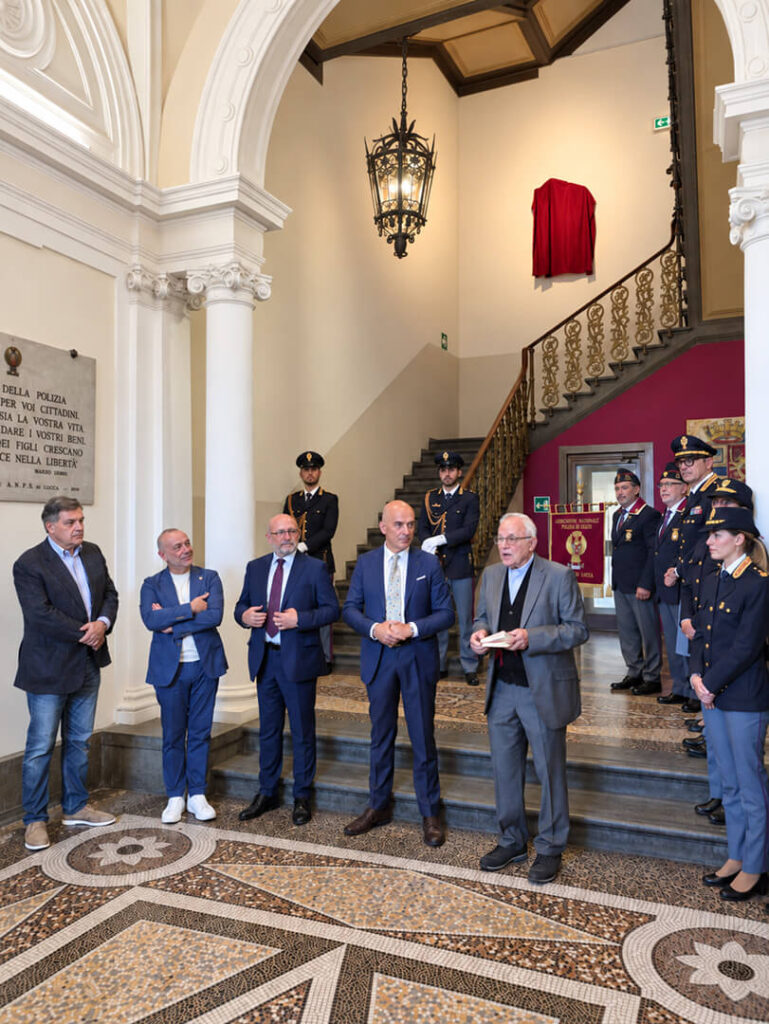
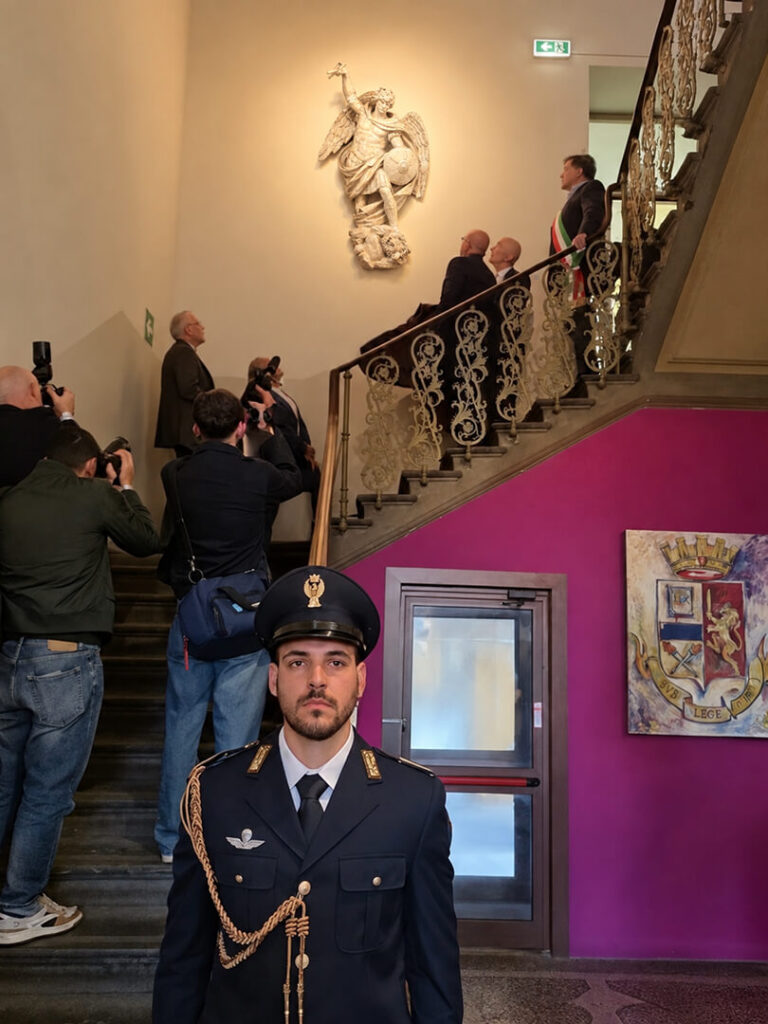
My relationship with this model, however, was not that of a chance encounter. I have known Eylanbekov for some time, and in Pietrasanta I often come across him in the city’s major sculpture workshops. There is also a second circumstance that inevitably shapes my view: I serve in the Polizia di Stato, the Italian State Police, and Saint Michael the Archangel is its patron saint. He is therefore a figure I know beyond the history of art as well, through a symbolic tradition that accompanies our institution each year on 29 September. When, in conversation with Eylanbekov about his Saint Michael, the idea arose that the plaster model might be given to the Lucca Police Headquarters, the connection was immediate. Precisely for that reason, however, it had to be approached with some caution: so evident a symbolic correspondence risks explaining the work before one has actually looked at it.
I had the opportunity to return to it several times, to study it at length and to discuss with Eylanbekov the reasoning behind some of his choices. One sentence from those conversations has stayed with me, almost as a provocation: his Saint Michael is beautiful precisely because he is invented. Nothing like him exists in nature, and yet we recognise him. Eylanbekov goes back to the Greeks and to a principle that is simple to state but far more difficult to put into practice: kata métron, according to measure.
But we need to be precise about what that means.
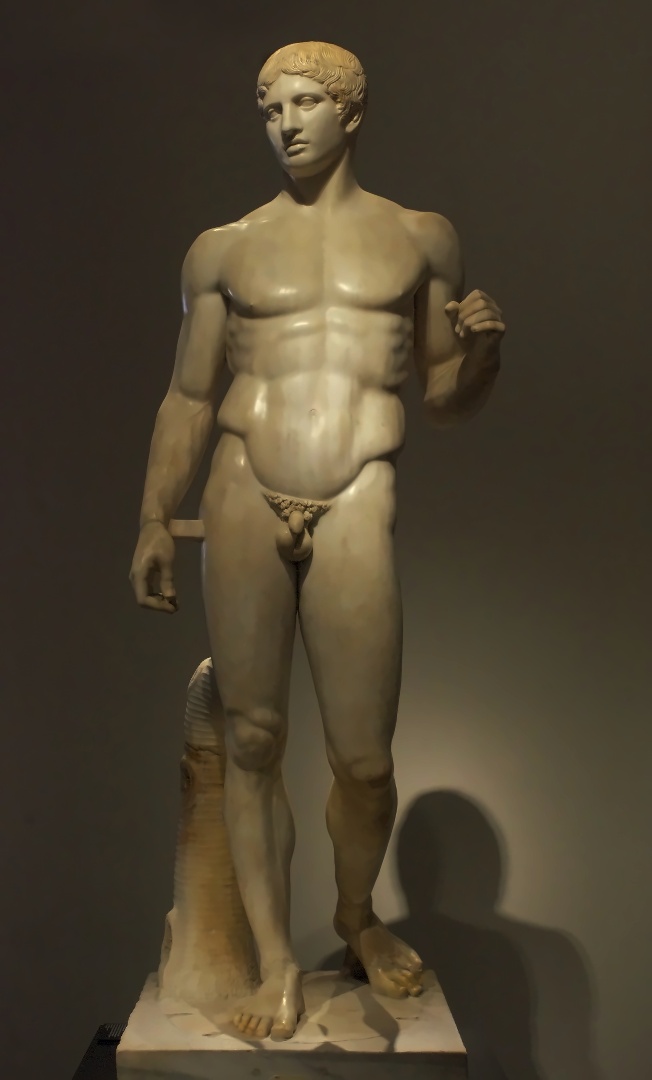
When we speak of the classical canon, we almost always think in terms of proportion. Polykleitos’ Canon (c. 450 BC) did indeed seek a foundation for beauty in the relationships between the parts of the body, and the Doryphoros gives that principle figurative form. But this body is not a portrait. It is an ideal construction, observed closely enough to seem alive and regulated carefully enough never to coincide with any single individual.
Eylanbekov works within a tradition that knows this register well. The anatomy of his Michael is credible, but the sculptor does not simply reproduce what he knows: he selects, intensifies and corrects. The torso displays a degree of idealisation that goes beyond straightforward anatomical transcription, while the musculature is organised so that it can also be read from a distance. The action has already begun and the arm bears the sword, yet the body does not erupt into violence.
We could stop here and call all this measure.
That would be too easy.
A good figurative sculpture knows how to govern a body, distribute its weight and contain a gesture. Composure alone does not prove that a work is addressing limits or the control of force. If we are to take seriously what Eylanbekov says about his own work, we need to find something more specific within the sculpture itself.
The face offers a first clue.
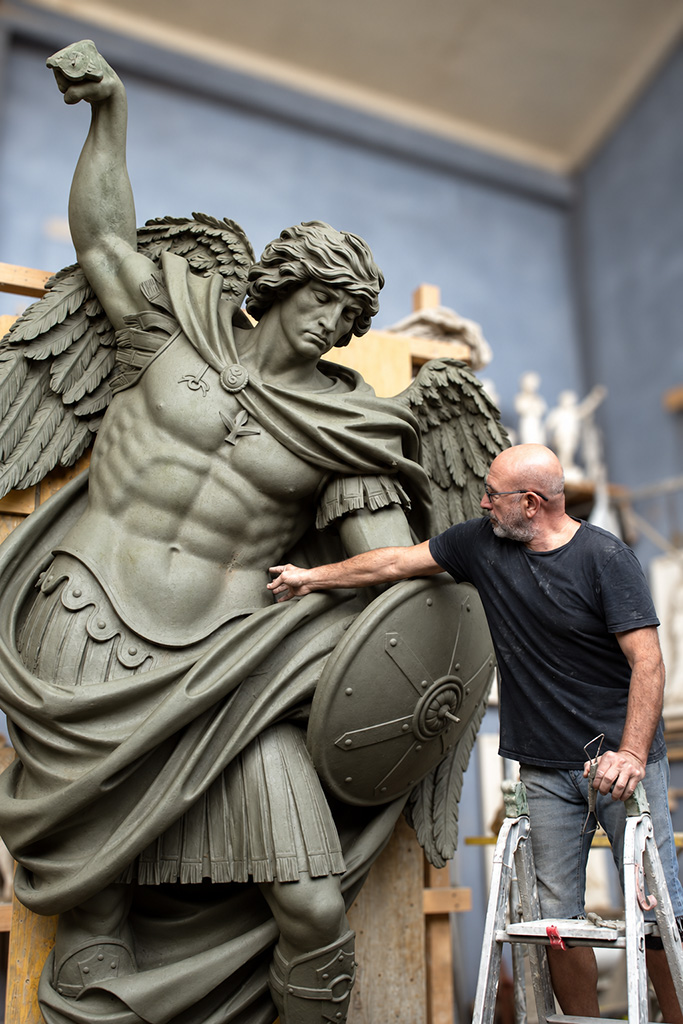
Photo courtesy of the artist.
From a fighter against evil we might expect fury, a grimace, at the very least the satisfaction of victory. Eylanbekov chooses otherwise. The eyes are lowered, almost closed; the mouth remains still even as the action unfolds.
It is difficult not to think of the formula through which Winckelmann helped shape the modern idea of Greek sculpture in the eighteenth century: “noble simplicity and quiet grandeur.” That quiet did not necessarily imply an absence of energy. A century and a half later, Warburg would approach antiquity from another direction, looking precisely for the tensions and formulas of pathos capable of surviving within images.
A composed face, by itself, still proves nothing. Winckelmann and Warburg help us read this tension, but they are not enough to explain what is distinctive about this Saint Michael.
To understand that, we need to stop looking at Michael for a moment and lower our eyes.
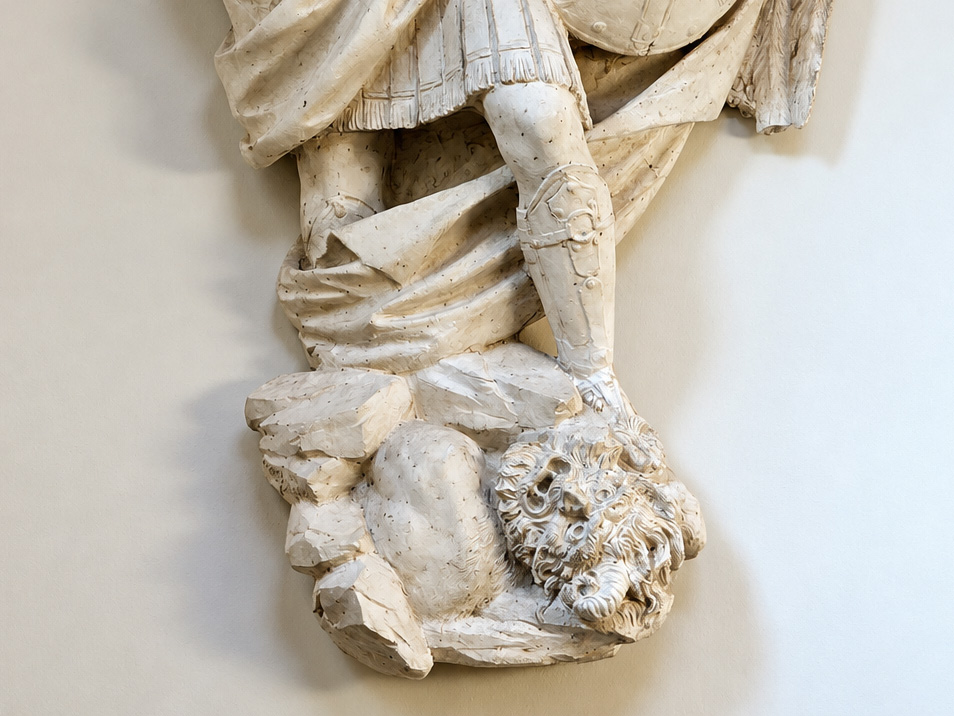
At the base, the defeated adversary emerges.
È qui che la lunga storia dell’immagine cristiana diventa interessante. San Michele appartiene alla tradizione biblica, ma l’arte occidentale gli ha dato ripetutamente il corpo dell’eroe: armato, alato, in piedi sul nemico. Il soggetto è cristiano; una parte del linguaggio attraverso cui abbiamo imparato a riconoscerlo porta con sé forme provenienti dall’antico. Non sono due tradizioni rimaste separate. Nei secoli si sono attraversate e trasformate.
Nel Grande San Michele dipinto da Raffaello nel 1518 per Francesco I, oggi al Louvre, l’arcangelo domina il demonio attraverso un corpo leggero e dinamico. Più di un secolo dopo Guido Reni costruisce un’immagine destinata a una fortuna enorme: il suo San Michele Arcangelo sconfigge Satana (1635 circa) per la chiesa dei Cappuccini a Roma viene tradotto quasi immediatamente in incisione e replicato a lungo. Il volto dell’arcangelo rimane sereno mentre quello di Satana, sotto di lui, si contorce.
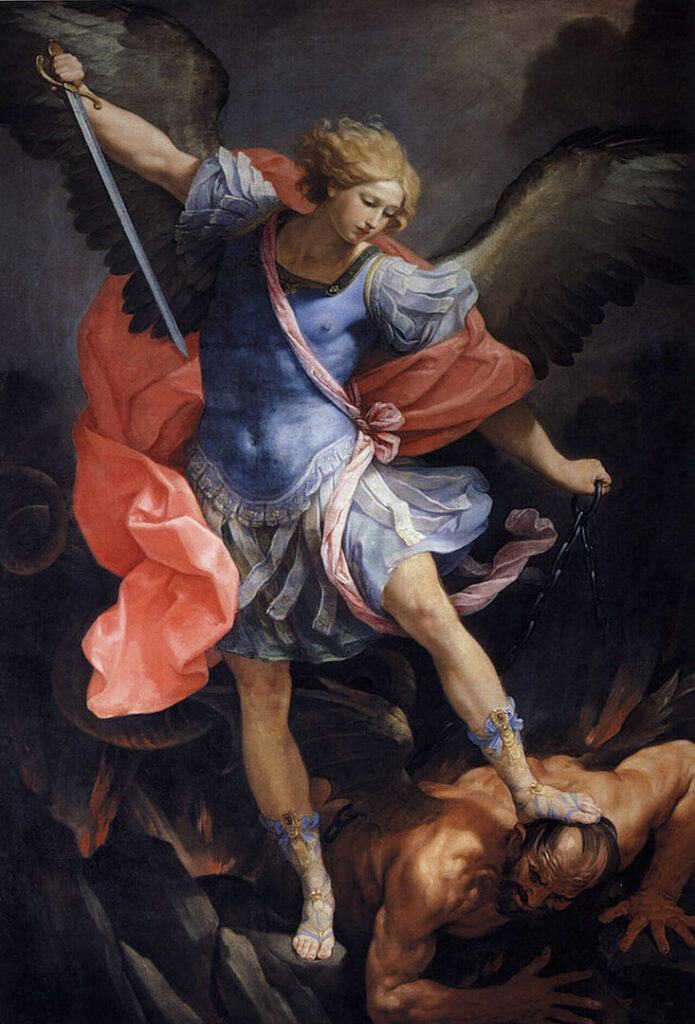
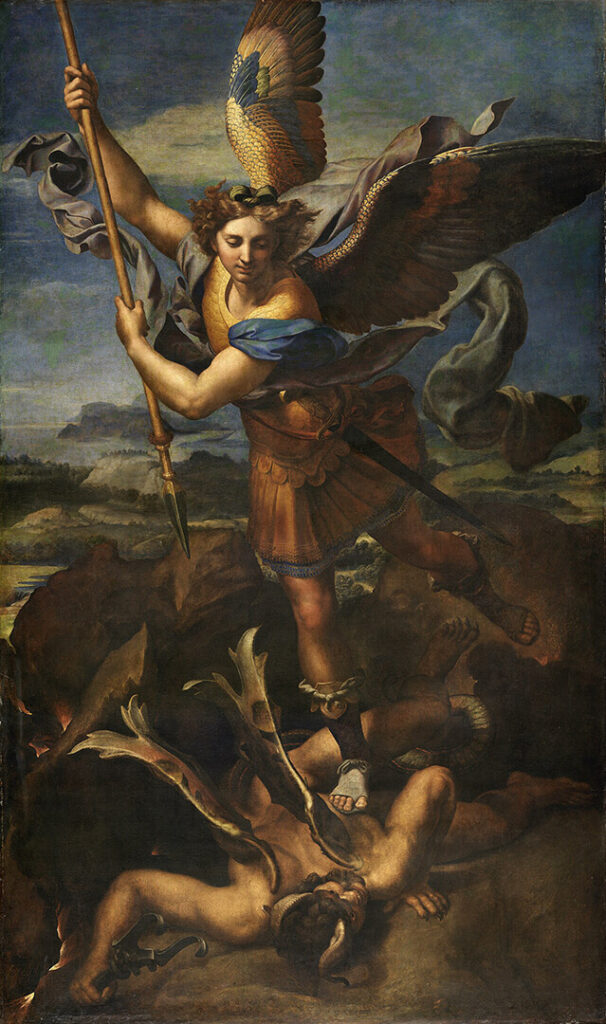
That contrast is part of how the image works. Michael’s victory becomes more legible through the defeated body.
Something different happens in Eylanbekov’s model. The vanquished figure emerges from the most irregular part of the base, while the archangel’s foot remains separate from the body below. The sword has not already entered the flesh. Victory remains intelligible without the physical contact that, in so much earlier iconography, made the enemy’s subordination explicit.
I would not call this pity, because I see no compassion in the work. I see a more precise choice: the suffering of the adversary is not used to magnify the power of the victor.
It is a small difference. That is precisely why it interests me.
The reference to the classical tradition explains where part of Eylanbekov’s language comes from. It is still not enough to tell us what this sculpture has to say. The treatment of the defeated figure, however, allows us to see where that language produces a specific choice here. The composition could insist more heavily on defeat, but it does not. It could show the enemy crushed, pierced, displayed. Victory remains legible without requiring the spectacle of humiliation.
At this point I return to the kata métron from which I began.
It now works differently. No longer as a formula imposed on the work from outside, but as a hypothesis that the work itself seems, at least in part, to confirm. To the measure of the body is added the measure of the gesture. And here, with due caution, one may also invoke sophrosyne: self-command, moderation, the capacity not to be carried away by excess.
Measure thus begins to concern the exercise of force.
And it is difficult not to notice this when the sculpture enters a Police Headquarters.
There is one temptation worth resisting: turning Saint Michael into an allegory of the Polizia di Stato. The warrior archangel, public force, good defeating evil. It would be an immediate reading. Perhaps too immediate.
A Police Headquarters is a place crossed every day by conflict, complaints, vulnerability and operational decisions. Here, force is not an aesthetic category. It can become concrete, and precisely for that reason it is regulated, entrusted, subjected to limits and responsibility.
The sculpture does not illustrate all this, nor should it. Its presence, however, makes it difficult to avoid a question that might feel less urgent elsewhere. Michael carries a sword and a shield. The first makes intervention possible; the second protects. But above all there is that defeated body beneath him, which is not turned into a spectacle.
Force, by itself, does not contain its own justification.
Then there is the plaster. It is fragile, marked by the process of making, still bearing corrections and surfaces that the next stage may alter. It would be easy to turn this too into metaphor: an armed figure constructed in a vulnerable material. But that fragility belongs to plaster before it belongs to the meaning of the work.
What the model actually reveals is more concrete. It shows that this image of force was constructed. Decisions were made, reconsidered, corrected. What may later appear inevitable in bronze still shows here that it was chosen.
Eylanbekov gave me a very concrete example of this distinction when speaking about his work for the Eisenhower Memorial in Washington. In the figures of the paratroopers, historical documentation mattered: the uniforms and equipment had to belong to that precise moment, on the eve of the Normandy landings. The faces, however, do not reproduce identifiable soldiers. He invented them. Certain elements of the figures were also accentuated because they contributed to the tension of the scene.
It is a distinction that interests me greatly. There are points at which accuracy is necessary, and others at which accuracy is not enough.
A portrait of Napoleon reproduced with absolute exactitude on a particular day of his life would be an extraordinary document of that instant. It does not follow that it would succeed in constructing what, in our memory, we call Napoleon. Art selects, discards and condenses different moments into a single presence.
That is where craftsmanship lies. Beyond craftsmanship, everything else begins.
Standing before Saint Michael, I return once more to Eylanbekov’s phrase. That body is beautiful because it is invented. After looking at it for a long time, I would add only one thing: invention does not necessarily lie where we first notice it. It is not only in the ideal body or in the memory of the classical tradition. It may lie in a foot that does not crush, in a sword that has not yet struck, in the way a victor occupies the space above the one he has defeated.
That figure now stands in a Police Headquarters.
It offers no moral and does not absolve in advance those who exercise force. It does something more useful: it keeps the limit visible.
Sergey Eylanbekov, Saint Michael the Archangel, plaster model, approx. 120 cm high. Donated to the Lucca Police Headquarters.
This article was automatically translated from Italian. The original text reflects the author’s thoughts – please be
aware of potential linguistic differences in the translation.

The contents on this website are protected by a Creative Commons
license. 👈 Click on the image to learn more.