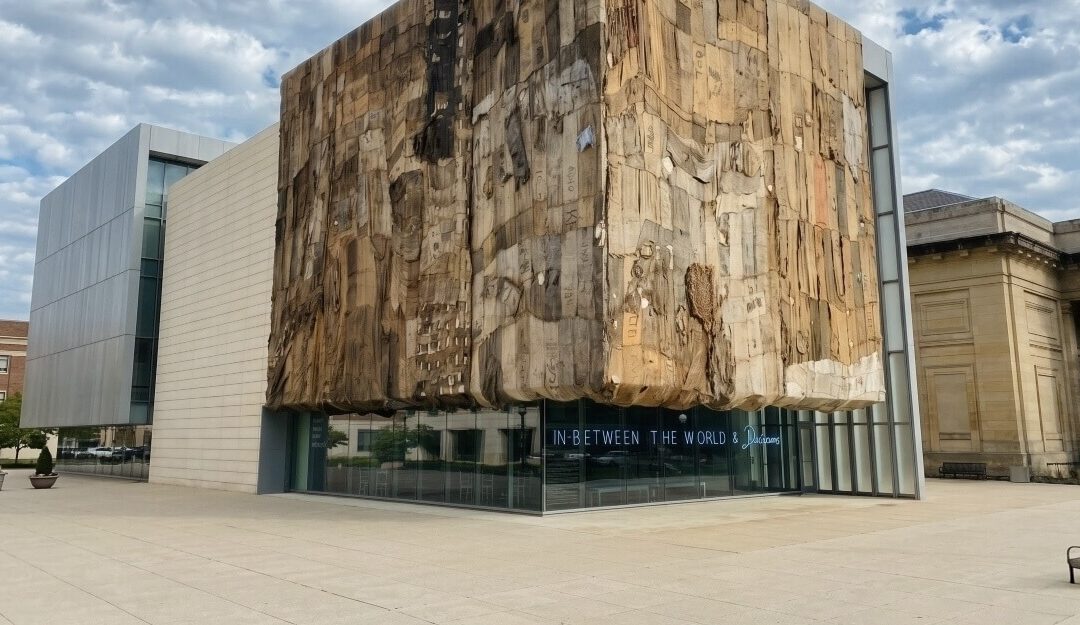
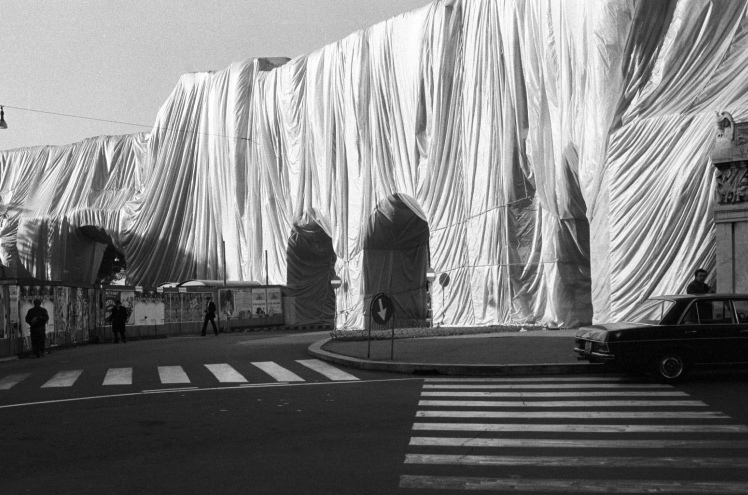
Someone looks at a work by Ibrahim Mahama, sees a sewn, torn, weathered jute sack, and thinks of Burri. That sack climbs a wall, wraps a sail, binds an architectural structure, and the reflex immediately changes name: Christo and Jeanne-Claude. It is a shortcut so quick that it can seem intelligent, when in fact it is often nothing more than an automatic response.
In that rapid, almost automatic passage from eye to language, an operation takes place that deserves attention. Not because the name that comes to mind is wrong in any obvious sense, but because that name is already a closure. It is the moment when formal recognition takes the place of analysis.
The gesture is understandable. That is how the mind works. Daniel Kahneman described it in a spare formula: “what you see is all there is” (WYSIATI). Fast thinking constructs coherent stories from what is visible within the frame and systematically ignores the variables that do not appear within it. The jute is visible. The stamped marking on the sack, the code of the cocoa supply chain, the route from Tema to Kumasi, the economy of Ghanaian charcoal, the political weight of postcolonial material: none of this is visible at first glance. To see it, you have to know to look for it. And even then, it is less memorable than the silhouette.
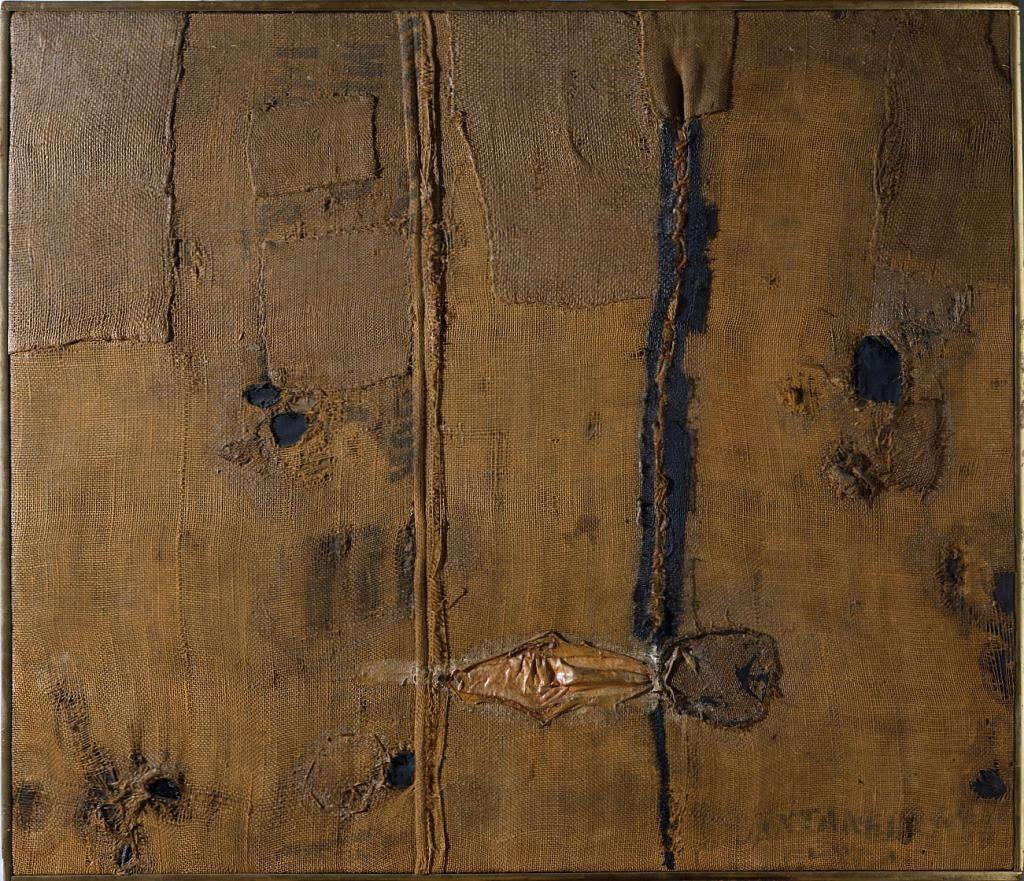
Reducing Mahama to Burri is methodologically insufficient. He uses sacks with a documented biography: not neutral objects, but physical archives of a global circulation of goods and labour. To reduce them to a formal variant is to replace a systemic reading with a visual equivalence. And in that substitution, everything that makes the work specific is lost: the context of production, its provenance, the artist’s historical agency, Enwezor’s curatorial frame in Venice, which helped construct its meaning. Resemblance, taken on its own, is a very poor compass.
The problem is not confined to art. It concerns the way public discourse, not only discourse on art, is built through stark oppositions. Quality or mediocrity. System or authenticity. Value or decoration. These pairs are convenient because they produce memorability and frames. They are impoverished because they construct the field selectively: every subsequent datum is read as confirmation of the initial anchor. Tversky and Kahneman gave this mechanism a technical name. Those familiar with investigative environments recognise it by a different term: cognitive tunnel vision. One sees only what the frame has already authorised one to see. Something can be set against this way of reading. Not a formula, but a method. When Giovanni Morelli, at the end of the nineteenth century, proposed attributing old master paintings not through their most conspicuous features, such as composition, expression, or subject, but through involuntary details, through the way an artist drew a fingernail, the fold of an ear, an earlobe, he made an epistemological move that Carlo Ginzburg would later describe as the “evidential paradigm”.
This mode has a cost. It requires time, it requires the suspension of judgement, it requires a willingness to let the picture remain unsettled while one is working. It does not produce slogans or effective titles. Over time, it produces readings that are more resistant to refutation.
There is a passage in Ginzburg that deserves to be kept close at hand whenever one reads anything: a work, a territory, a situation. What he says, in essence, is that in certain fields of knowledge rigour cannot be rigid. It must be elastic. Because the singularity of data, whether one is dealing with a work, a clinical case, or a crime scene, cannot be formalised without losing what makes it recognisable. Elastic rigour is the opposite of binary thinking. It does not seek the strong synthesis. It seeks the coherence of the overall design when one moves across the carpet in different directions. To apply this gaze to a work like Mahama’s means accepting that one does not know it immediately. It means looking at the material as a document before looking at it as form, and asking what it carries with it. It means asking under what conditions that jute became a work of art, who recognised it as such, within which curatorial debate, and against which genealogy of thought: a genealogy that may include Burri, certainly, as an initial comparative hypothesis, but which is not exhausted by that reference and also includes the thought of authors who have analysed the global economy from the condition that produces it. Formal resemblance is the poorest point of departure, not the most reliable one.
The discourse that reduces everything to binaries, this has value, this does not; true art, fashion, remains effective for as long as no one tests it. It rests on the repetition of strong anchors: “crisis”, “speculation”, “regime”, words that orient the reader before the analysis has even begun. It works as long as the system remains closed. When it opens to an unforeseen variable, the missing document, the biography of the material, the context of production, the frame reveals its fragility. At that point, either one admits complexity or one reintroduces the same dichotomy at a higher level, in different words.
The issue, then, is not whether criticism of the art system is legitimate. The real tensions exist, and many analyses identify them with precision. The point lies elsewhere: what logical structure sustains that criticism? When reasoning is organised through stark oppositions, and when metaphors, analogies, and generalisations replace the explicit statement of criteria of proof, discourse often gains in immediacy but loses in analytical strength.
This is not only a problem of art. It is also a problem for anyone who has to read the present. The way a critic attributes a work on the basis of visual resemblance is the same way in which, on hearing hoofbeats, one expects a horse and is not prepared to see a zebra. Dichotomy is always more economical than method. Narrative is always more restful than inquiry. But reality, when it leaves a useful trace, rarely places it in the most conspicuous spot: it leaves it in the lateral details, not at the centre of the image. To read a work does not mean finding the right name to pronounce at once. It means resisting the haste to close it within a category. That is what method is for: not to make judgement harsher, but to make attention more vigilant.
The true innovation, in a time that confuses speed with intelligence, does not lie in knowing how to simplify. It lies in knowing how to remain with the detail long enough to let the detail speak.
This article was automatically translated from Italian. The original text reflects the author’s thoughts – please be
aware of potential linguistic differences in the translation.

The contents on this website are protected by a Creative Commons
license. 👈 Click on the image to learn more.