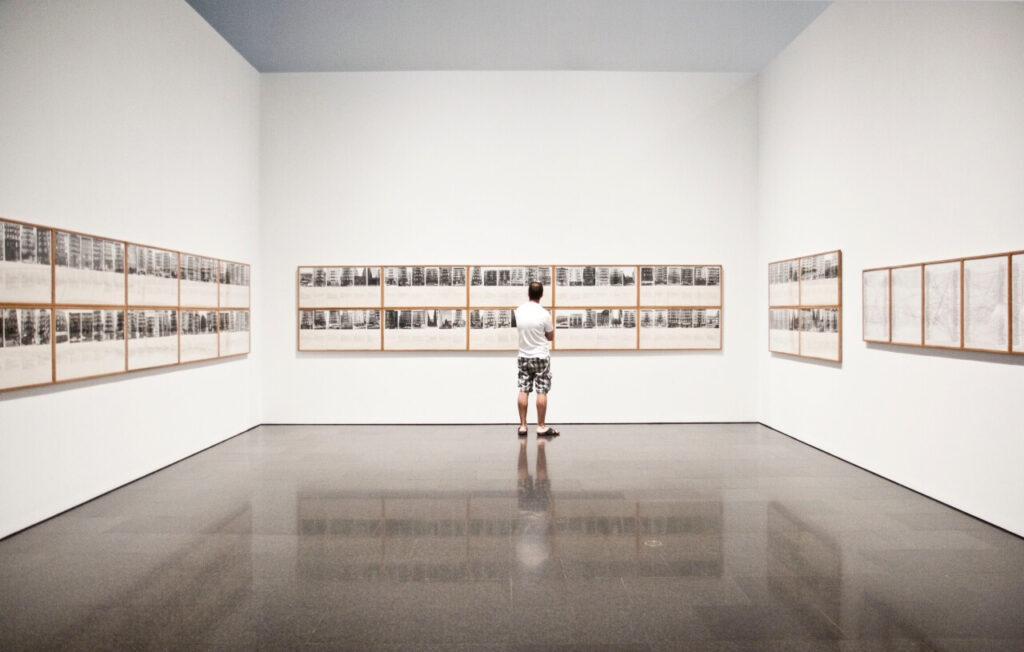
New York, spring 1971. A German artist spent months in the city’s public archives: property records, notarial deeds, corporate registrations. He photographed 142 buildings in the South Bronx, Harlem, and the Lower East Side. Dilapidated tenements, stairwells without hot water, overcrowded apartments. Then he constructed the work: each photograph paired with a record card. Owner. Address. Transactions.
From those documents, something emerged that had never been made so visible: all those buildings, different in appearance and scattered across different neighbourhoods, were tied to the same network. Interconnected families, companies that changed name but not ownership. A single system with many faces.
Hans Haacke titled the work Shapolsky et al., “Shapolsky and others,” after the principal owner identified in the records. He does not accuse. He does not comment. He shows, and lets the data speak.
The Guggenheim Museum invited him to a major retrospective, a rare distinction for a thirty-five-year-old artist. Then, six weeks before the opening, the exhibition was cancelled. The curator who had organised it was dismissed. The official reason: the museum’s “aesthetic and educational” aims were deemed incompatible with a work of a political nature. Art, the Guggenheim maintained, should remain neutral.
A privately funded institution that decides what the public may see, and defends itself by invoking neutrality precisely while censoring those who challenge it: this is the second level of Haacke’s work, the one the cancellation made unintentionally visible.

Source: Coleman & James (eds.), Capitalism and the Camera, Verso, 2021, via ResearchGate. Licensed under CC BY-NC-SA 4.0.
The installation takes on a configuration that evokes an urban profile constructed through images and data.
Keeping this story in mind helps us see differently what is happening in Fiumetto, on the Pietrasanta coastline.
Bagno Felice changes name, changes form, changes price range. It becomes Tala Beach: forty cabanas, a swimming pool, premium services, a season priced between ten and twelve thousand euros. The investment exceeds two million. Fifty-five jobs have been announced, twenty-five of them intended for local residents. (La Nazione, 11 April 2026, Versilia local news)
These are announced figures. No one is disputing them.
The useful question is not whether this operation is right or wrong. That kind of question almost always leads to ready-made positions, and is of little use. More interesting is to ask what this operation makes visible: what does it tell us about the territory in which it is taking place, and about those who inhabit it?
A stretch of coastline is not merely a place to go in summer. It is a place in which a community recognises itself, a place people return to every year, a place where they bring their families. When that place is reorganised around an economic threshold that most people cannot afford, something subtler than simple exclusion occurs: it slowly ceases to feel like yours. Not because anyone forbids you to pass by, but because the language of that place, its price, its aesthetic, its very offer, no longer speaks to you.
Versilia has known this mechanism for a long time. Second homes, elite seasonal tourism, services designed for those who arrive rather than those who remain. Pietrasanta and Forte dei Marmi have for years been case studies in debates around affordability, an English word that sounds slightly awkward in Italian, but means something very simple: how many people can still afford to live here.
Tala Beach is not the cause of this process. It is a point at which the mechanism becomes legible with particular clarity.
The counter-argument exists, and it is only fair to take it seriously: projects of this kind bring jobs, visibility, and economic spin-off. An attractive territory generates wealth. To ignore that would be to oversimplify.
Precisely for that reason, however, the question becomes more difficult: can a town grow in value without losing its ability to function for those who live there all year round?
Haacke did not answer. He showed the map and let the mechanism reveal itself. The Guggenheim censored him because that map hurt too much for those who recognised themselves in it, not as victims, but as protagonists.
Perhaps looking at the data on Fiumetto with the same degree of attention, without searching for culprits and without romanticising the past, is already a way of asking the right question. What kind of place do we want this stretch of coastline to be in twenty years’ time, and for whom will it still truly work?
This article was automatically translated from Italian. The original text reflects the author’s thoughts – please be
aware of potential linguistic differences in the translation.

The contents on this website are protected by a Creative Commons
license. 👈 Click on the image to learn more.