Not a technical guide to voice scams, but an analysis of what fractures when a fundamental human signal – the voice – ceases to function as a guarantee.
The first thing that is lost is not money. It is the voice.
When a community discovers that the voice of a child can be reproduced, cloned, imitated with enough precision to deceive a mother or a grandparent, the damage is no longer measured in euros. It is measured in hesitation. In unanswered phone calls. In sudden silences.
Recent news reports describe attempted scams targeting the elderly through artificial intelligence, voices imitating family members, urgent requests for help.
The kind of news that flows past without leaving a trace. And this is precisely where the misreading lies: treating it as a technological variant of an already familiar problem.
In reality, we are not facing a more “advanced” scam. We are facing a rupture in the mechanisms of human recognition.
For centuries, the vocal trace has functioned as an informal yet extremely powerful form of proof. Not legal proof, but social proof. Recognizing a voice meant recognizing continuity: a bond that withstood distance, darkness, the absence of the body. The voice arrived before verification, and often made it unnecessary.
Traditional fraud worked through narrative: a plausible story, a credible role, a simulated authority. Here something different happens. The fraud no longer tells a story; it replicates an identity signal. It does not persuade. It is recognized. Or rather, it appears to be. This shift is decisive. The deception no longer passes through content, but through the perceptual channel. It does not lie; it imitates. This is a mechanism that science fiction had identified with clarity long before technology made it practicable.
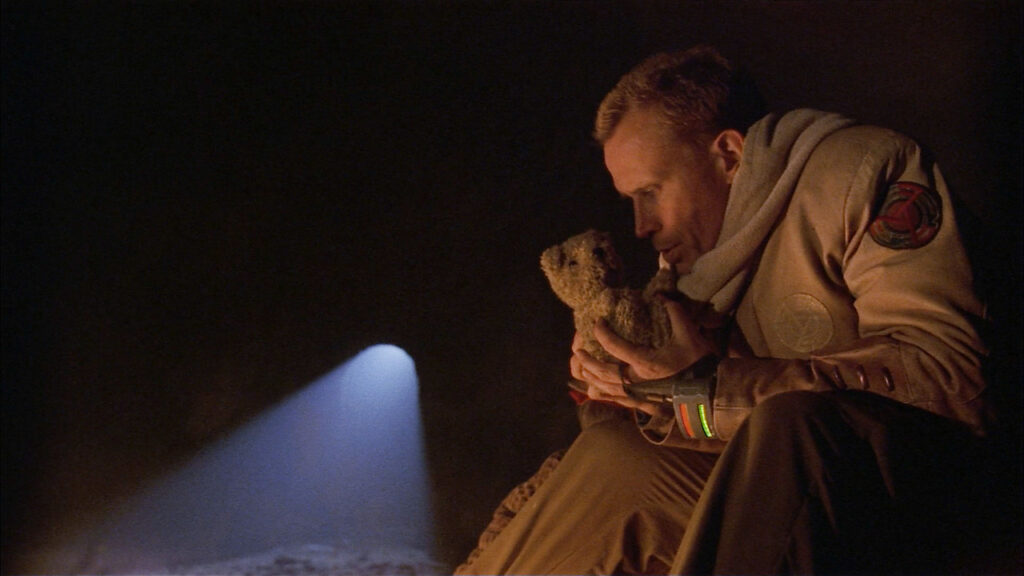
The “child” as a device for manipulating the human signal.
In the film Screamers, based on a short story by Philip K. Dick, the machines at war with humans do not prevail by increasing firepower. They prevail by changing cognitive strategy. They appear in the form of children, alone, wounded, pleading. They do not attack the soldier’s rationality; they attack his ethics. The trap works only if the human responds to a request for help. The point is not plausibility. The point is the moral irresistibility of the signal. This dynamic is not new in the history of images.
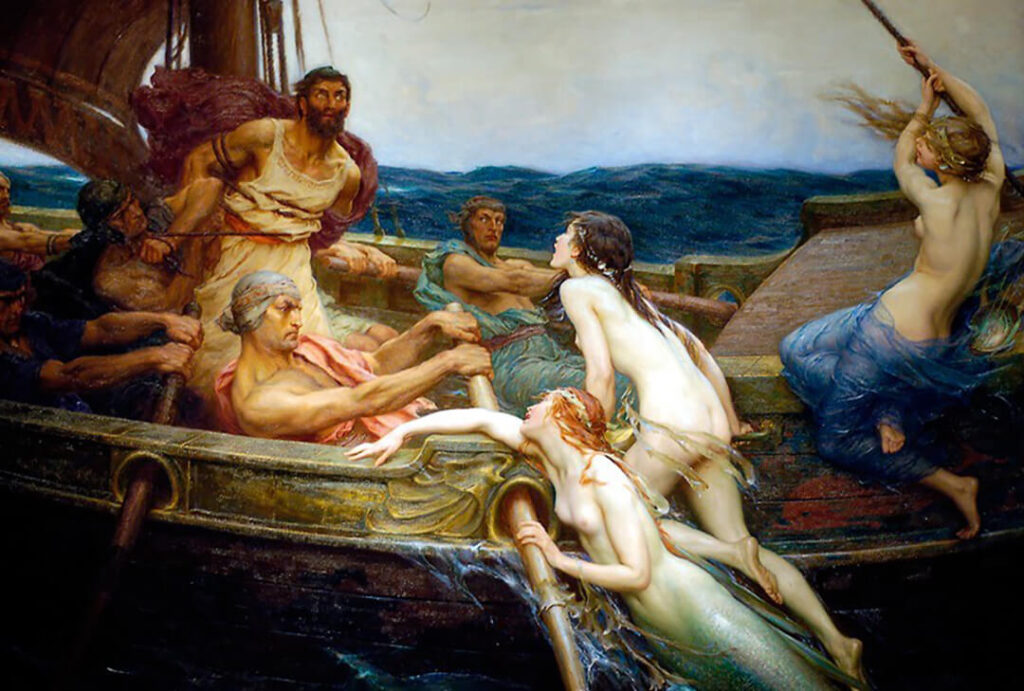
Oil on canvas. Episode from the Odyssey: Ulysses, bound to the mast, listens to the Sirens’ song without yielding. An allegory of the seductive power of the voice and of the need for rational mediations to resist deception.
In Ulysses and the Sirens by Herbert James Draper, Ulysses is not saved by force or by reason. He is saved because he anticipates the trap of the signal. He knows that the song is not false, but irresistible. For this very reason he asks to be bound and has his companions’ ears stopped. Draper does not depict the monster, but the critical moment: the moment in which seduction works because it speaks to desire, not to error. The Sirens do not deceive: they call. Their song is not false; it is simply unverifiable. And the problem is not the lie of the song, but its capacity to suspend all verification.
AI-driven voice scams function in the same way. Not because the victim “does not understand,” but because they recognize. The voice of a child, a grandchild, a family member activates an automatic, pre-rational response grounded in trust. It is a primary human protocol, refined over centuries to make social life possible. When this protocol is violated, the damage does not remain confined to a single episode. In everyday life there are verification systems with low cognitive cost. The voice is one of them. If I recognize it, I can trust it. If I can trust it, I can act. When this system collapses, it is not replaced by a more efficient one. It is replaced by suspicion. And suspicion is not selective. The most significant social effect of these frauds is not the direct victim, but the collective withdrawal they produce. The elderly person does not simply become more cautious; they become more isolated. They answer the phone less often. They distrust even authentic calls. They reduce contacts and interrupt already fragile relational flows. Technology strikes here because it finds a predisposed terrain. Older people are more exposed not only because of lower digital skills, but because the voice remains for them a central instrument of relationship. Not chat, not video, not multiple authentications.
Telephone. Voice. Trust.
When the voice becomes unreliable, the only defense proposed is protocol: code words, passwords, agreed procedures. But protocol is not neutral. It turns a relationship into a procedure. It introduces friction where there was once immediacy. It demands training, memory, discipline. It asks us to live in a permanent state of verification.
This is where the local episode ceases to be local. Because what is being eroded is not economic security, but trust as the invisible infrastructure of everyday life. A community functions because most interactions are not verified. People recognize one another. They believe one another. They act. When this mechanism jams, the cost is not immediate but diffuse: a loss of fluidity, spontaneity, openness.
Public discourse responds poorly to these fractures. It reduces them to a technological problem (“it’s AI’s fault”) or turns them into a criminal emergency (“we need more controls”). Both readings are partial. The first absolves the social context of responsibility; the second promises a repressive solution to a problem that has already entered minimal gestures, habits, homes. Technology does not create the problem here. It makes it visible.
Philip K. Dick had identified the knot in advance: the separation between sign and origin.
The voice without the body. – Presence without guarantee. – An identity reduced to a replicable surface.
For decades, art and science fiction have explored this fracture, anticipating its symbolic and cultural implications. Today that same fracture is no longer an imaginative exercise. It manifests as everyday experience, as a minor but widespread rupture. We are not prepared to doubt the voice. We are not trained to question intimacy when it presents itself as sound. The reaction, then, is not analytical but defensive: contact is reduced, response is suspended, distance is introduced. Relationship itself is treated as a vulnerability.
Read in this perspective, the local news story does not describe naive elderly people or particularly sophisticated criminals. It describes a threshold that has been crossed. The precise moment in which an elementary human signal ceases to function as a shared guarantee.
And when a community loses a minimal criterion of authenticity, it does not replace it easily. It may stiffen, slow its exchanges, compensate with procedures and precautions. Or it may accept, more or less consciously, to live within a regime of permanent suspicion.
This is the true object of the narrative.
Not technology in itself.
Not the single episode of fraud.
But the invisible cost that accumulates when the voice, on its own, is no longer enough.
And yet, this fracture is not a definitive condemnation. Every time a technology disrupts a human automatism, it also forces that automatism to become visible. Trust is not a lost instinct, but a competence that can be renegotiated and relearned. We will not trust as we did before… but we may learn to trust better, with greater awareness of what truly makes a signal human.
In the ancient language of the Psalms, this threshold takes the form of a cutting image: “His mouth is smoother than butter, but war is in his heart; his words are softer than oil, yet they are drawn swords” (Ps 55). Here the voice does not lie; it seduces. It is when the signal is perfect that trust ceases to be a reflex and becomes a responsibility.
This article was automatically translated from Italian. The original text reflects the author’s thoughts — please be
aware of potential linguistic differences in the translation.

The contents on this website are protected by a Creative Commons
license. 👈 Click on the image to learn more.