You don’t need a title to be capital when beauty is a way of life.
Florence, January 29, 1475.
The Piazza of Santa Croce swarms with anticipation. The entire city has gathered to witness a spectacle that transcends the chivalric contest itself: a total performance of power, grace, and passion.
Among the banners fluttering in the winter wind advances Giuliano de’ Medici, a radiant knight beneath a finely engraved breastplate, upon which gleams the effigy of Medusa – the most fearsome of the three Gorgons, the only mortal one, yet endowed with the power to turn to stone with her gaze – an apotropaic emblem and a portent of fate (cf. the bust of Giuliano de’ Medici attributed to Andrea del Verrocchio, National Gallery of Art, Washington).
Giuliano’s joust was not merely a test of courage but a display of might.
Ser Giusto Giusti of Anghiari, in his Giornali (ca. 1475), records that more than two thousand pearls were purchased to adorn the doublets and the caparisons of the Medici horses: a sumptuous apparatus conceived more to dazzle than to endure.
In a competition of shocks and collisions, such ornaments appeared utterly unsuitable – precious, fragile, destined to be ruined. And yet it is precisely there that the deeper meaning of the gesture is revealed.
The Medici flaunted their wealth, knowing that such luxury would be consumed in the very game of the joust – a power so solid it could afford waste.
As Giulio Busi, historian and interpreter of Renaissance imagination, observes, the legend of the “lost pearls” reflects the spirit of an age: the pride of a dynasty that never bows, not even before loss itself.
“The Medici never stoop to pick up the fallen pearls” thus becomes more than a moral maxim – it is the perfect synthesis of a power that makes beauty its weapon and risk its measure.
Over the field looms the dark gaze of Francesco de’ Pazzi, the man who, two years later, would turn that rivalry into blood and conspiracy.
The joust, then, is far more than a tournament: it is the symbolic theatre of a Florence gazing at its own beauty, unaware of the precipice that awaits it.

The Lady and the Poet
Giuliano’s joust was dedicated to a woman: Simonetta Cattaneo Vespucci, the “beauty of Florence,” Ligurian by birth but Florentine by adoption, married to Marco Vespucci, and celebrated by poets, painters, and philosophers alike. Her beauty was not merely aesthetic – it was a moral code.
Poliziano, commissioned by Lorenzo the Magnificent to immortalize the event, transformed it into the epiphany of a courtly and Platonic love: an exalted sentiment destined to sublimate itself into poetic form.
In his poem Le Stanze per la Giostra, Simonetta’s grace becomes the image of the soul, the Neoplatonic ideal of a perfection that transcends the flesh.
It marks the beginning of one of the most poignant and symbolic love stories in the history of art: a bond that was never consummated, yet survived life itself.
In the Florence of the Magnificent, love was not a private affair – it was a political and cultural device. Emotion became the architecture of imagination, a tool of cohesion and power.
Giuliano and Simonetta embody the impossible union of eros and virtue, a pure love that neither time nor death could dissolve.
Simonetta died on April 26, 1476, little more than a year after the joust; Giuliano fell on the same day – April 26, 1478 – pierced by the daggers of the Pazzi. Two deaths bound by a single date, as though fate itself had wished to complete the design of a myth.
Botticelli: Painter of a Lost World
Sandro Botticelli, the Medici’s favored artist, transformed that tragedy into visual language.
In his Venus and Mars (1482–1483, National Gallery, London), the mythological allegory intertwines with the echo of the joust and of mourning. Venus, reclining and contemplative, embodies beauty that has survived passion; Mars, asleep and disarmed by the mischievous satyrs, is the warrior defeated by desire.
This is not a mere mythological episode – it is a coded message. The conch shell that one of the satyrs blows as a trumpet recalls The Birth of Venus (1484–1485, Uffizi, Florence), where Botticelli would portray Simonetta herself – eternal and ideal.
Beside the god’s sleeping face buzz several wasps – the emblem of the Vespucci family – a hidden clue, an indizio in the sense described by Carlo Ginzburg: a minimal trace that unveils an entire universe of meaning.
Even the jousting lance lying next to Mars is no accident; it is not a weapon of war, but a direct reference to the tournament of 1475 – to that moment when love became a public spectacle and a promise of eternity.


From the Renaissance to Social Media: The Love Factory
Five centuries later, the dynamic remains unchanged.
The Renaissance shaped love through portraiture; today’s world shapes it through the digital image. Simonetta Vespucci was the “viral Venus” of Medicean Florence – circulated through poetry, painting, and the whispers of the courts. Now, the same operation unfolds through photography and social media, where eros becomes image and desire turns into narrative.
Like Botticelli, we too strive to eternalize what is born to die, capturing in a gesture, a face, a photograph, the memory of an absolute instant.
Now, as then, power is built through the staging of beauty: Medicean Florence foreshadowed what we now call the “society of the image.”
Love thus becomes a form of self-curation, a collective aesthetic construction. The tools change, but not the obsession – the pursuit of beauty as an illusion of immortality.
And yet, in certain places, beauty is not a memory but a daily practice.
There is a land where beauty continues to be a craft: the hand, the gesture, the material remain living languages, a direct legacy of that Renaissance season that Botticelli transformed into image.
Here, the joust has never stopped – it has merely changed its form.
Epilogue: The Eternal Return of the Image
Giuliano and Simonetta still live on – in the very memory of painting.
Botticelli entrusts them to eternity as two figures who never touch, and precisely for that reason, never fade.
He, the sleeping knight; she, the watchful goddess: love as dream and wakefulness, as distance and desire.
In their double death – the same day, the same month – unfolds a symmetry that only art could comprehend.
Perhaps Botticelli reminds us that love endures within memory: there, time suspends its course, and the image becomes the only possible form of resurrection.
Perhaps this, too, is the destiny of Pietrasanta – to preserve form as an act of remembrance and to keep transforming matter into thought.
After all, one needs no title to be a capital.
Here, beauty truly is a way of life.
Love, like art, is a way to resist nothingness. – a contemporary reinterpretation of a Renaissance thought
This article was automatically translated from Italian. The original text reflects the author’s thoughts — please be
aware of potential linguistic differences in the translation.
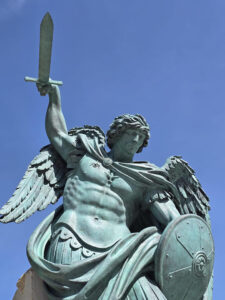
Featured image: Giacomo Lombardo via Pixabay (free licence)

The contents on this website are protected by a Creative Commons
license. 👈 Click on the image to learn more.