A Europe at a standstill between dark, competing forces
From Friedrich’s painting to contemporary geopolitical pressure: what it means to live in a world where imperial powers, opaque interests, and undeclared power games obstruct every possibility of movement, like a grip of ice that first slows, then immobilises, and finally, like a mythological kraken, crushes whatever can no longer move forward.
The ice according to friedrich
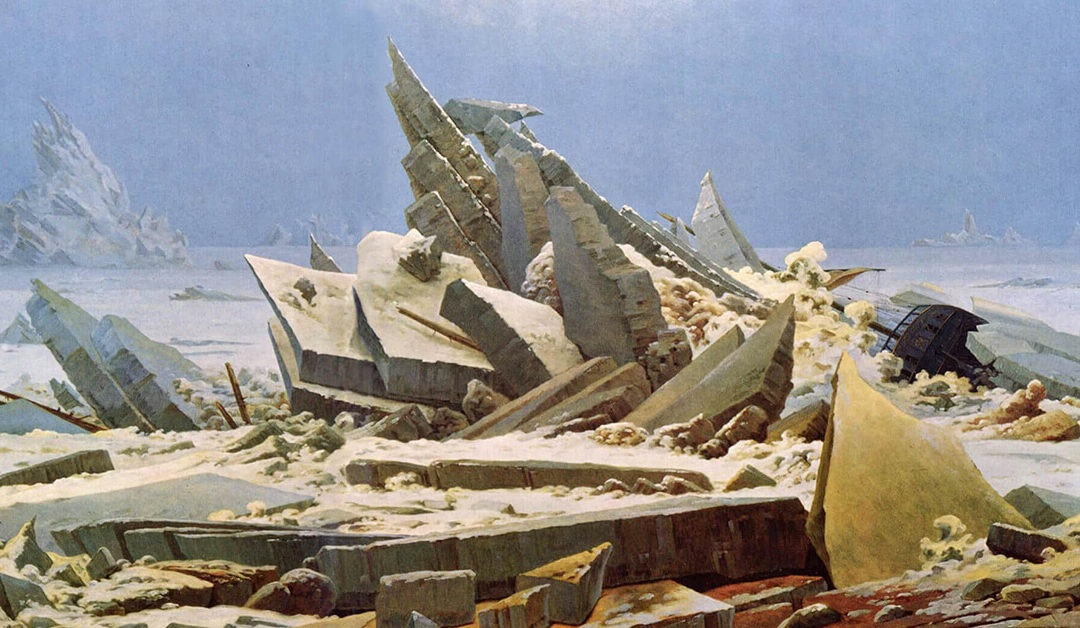
In Das Eismeer (The Sea of Ice), 1823–24, by Caspar David Friedrich, a ship lies motionless, held fast by a landscape that imposes its own logic before human will can even begin to act. It is a nineteenth-century image, yet it describes today’s Europe with striking precision: a continent that would need political movement in order to survive, and that instead remains blocked by forces that compel paralysis rather than direction. The painting does not introduce a discourse on art; it introduces a representation of the present.
In the painting, the sheets of ice pile up like tectonic structures, forcing the ship into an unnatural tilt. This is not a shipwreck, not yet. It is the moment when movement becomes impossible, when the environment no longer serves as a backdrop but turns into the very structure that conditions every possibility of advance. Friedrich presents a world in which will still exists, but no longer possesses the means to act upon reality. The essence of the image is not tragedy, but friction: a body designed to move forward that suddenly discovers itself trapped within the very shape of the world.

The ice according to geopolitics
This condition finds a clear echo in the recent geopolitical configuration. The international news of the past few days, the Trump–Putin axis, tensions with Kyiv, uncertainty in Brussels, the Pope’s voice calling Europe back to responsibility, outlines a political geography that, in its structure, recalls Friedrich’s painting. Europe does not lack will; it is placed within an environment in which every choice entails a loss, every step forward inevitably opens new vulnerabilities, and every stalemate risks turning into a deferred collapse.
Pressure from the United States, especially in its Trump-era form, introduces a deep disarticulation of the very idea of alliance. Not dialogue, but intermittent imposition; relationships that oscillate between friendship and hostility according to immediate advantage. On the opposite side, Russian pressure operates as a counter-mass, destined to compress the environment further rather than open it. Europe is not caught between two wills; it is compressed by two systems of force that, as in the painting, close precisely where a passage should open. In Arctic seas, icebreakers follow fracture lines and cross what the ice allows to be crossed; here, instead, every possible opening seals itself, turning the space for manoeuvre into a vise.
Seen through this lens, territories such as Versilia become sensitive indicators of what is happening on a global scale. When Europe does not protect, other actors advance. The growing interest of foreign funds and economic groups in coastal assets, beach concessions, real estate, and infrastructure is not a local paranoia; it is the natural consequence of a continent unable to give clear direction to its most valuable spaces.

Europe’s internal fault lines
Alongside this external tension runs an internal one: twenty-seven states sharing institutions but not priorities, intertwined economies that are anything but symmetrical, and foreign policies shaped not only by distinct historical paths, but increasingly by explicit national self-interest. Speaking of a “lack of decisiveness” is misleading. What is missing is not political will, but the willingness to pay its price. Every decision carries a high internal cost, in terms of consensus, government stability, and immediate risk; contemporary politics, driven by the urgency of not losing electoral ground, ends up managing only the emergency of the moment, never building a strategy.
Within this fragile balance, acting can fracture cohesion; not acting, however, gradually dissolves the very capacity to act. This is the European paradox: any direction requires a margin of courage that few leaders are willing to claim today. In times of crisis, absolute caution offers no protection; it merely shifts the cost forward. Missed decisions do not eliminate consequences, they postpone them; and when they return, they return amplified. This is the dynamic that erodes Europe’s ability to act: not a lack of will, but prolonged waiting at the very point where a line should be drawn.
The ship does not remain motionless because it refuses to move forward; it remains motionless because every deferred route becomes, over time, harder to navigate.
Meanwhile, territories more dependent on external factors, tourism, seasonality, coastal economies, are the first to feel the impact of uncertainty. Not because they are weak, but because they experience more directly the effects of decisions taken, or not taken, far away from them.
Why perception misleads us
Public perception amplifies this condition. We tend to focus on what is immediately visible: strong statements, rapid gestures, solutions presented as simple, while almost everything that requires slowness and complexity fades into the background. Daniel Kahneman (Nobel Prize in Economics, 2002) described this with great clarity. The mind tends to construct a complete story from a handful of elements, a mechanism he defined as WYSIATI: “What You See Is All There Is”, that is, the tendency to mistake the visible fragment for the whole picture and to build full judgments on partial information. As a result, those who raise their voice appear decisive, while those who mediate appear uncertain. Yet this is a cognitive illusion. What we perceive as weakness is often the inevitable effect of a political structure that must hold together twenty-seven states, not a sign of incapacity.
The european destiny as a shared journey
What holds a ship in place does not concern the crew alone; it concerns the entire journey. In the same way, what blocks Europe is never distant from its citizens. We are bound by centuries of history, intertwined traditions, memories that crossed borders long before modern politics existed. We cannot regard ourselves as external spectators. If the ice advances in one part of the continent, its pressure is felt everywhere. Unity is not born of utility, but of recognising that Europe’s destiny is a shared route; and that no ship survives alone in the sea of ice.
Every civilisation is measured by its ability to understand when ice is structure and when it is merely season. True movement does not arise from desire, but from the clarity with which one recognises the shape of the world one is called to navigate. “Navigare necesse est, vivere non est necesse”, Gnaeus Pompey the Great (106 BC–48 BC) reminded his sailors. Mission comes before fear.
This article was automatically translated from Italian. The original text reflects the author’s thoughts — please be
aware of potential linguistic differences in the translation.
The contents on this website are protected by a Creative Commons
license. 👈 Click on the image to learn more.