A method that outlives its author
Carlo Ginzburg died on 17 June 2026. He was the historian who described, better than anyone else, a way of knowing the world through traces: clues, symptoms, signs. It is a method I recognise in two different practices: technical crime-scene examination and the reading of works of art.
On a crime scene, everyone looks at the centre, but the real work begins at the edges. Not because the centre does not matter, but because it is the first site of attention, the place immediately occupied by the gaze. At the margins, by contrast, evidence settles with less noise. It is there that what Carlo Ginzburg, in a 1979 essay, called the evidential paradigm becomes useful: a way of knowing grounded in minimal traces, lateral signs, details that seem secondary only to those in a hurry to conclude.
You probably do not call it that. You do not turn it into theory straight away… you simply do it, because over the years method becomes a posture before it becomes thought. As with a musician who has repeated a scale until there is no longer any need to count it: the fingers precede the explanation. The gaze too, when it has been trained long enough, stops asking permission from theory.
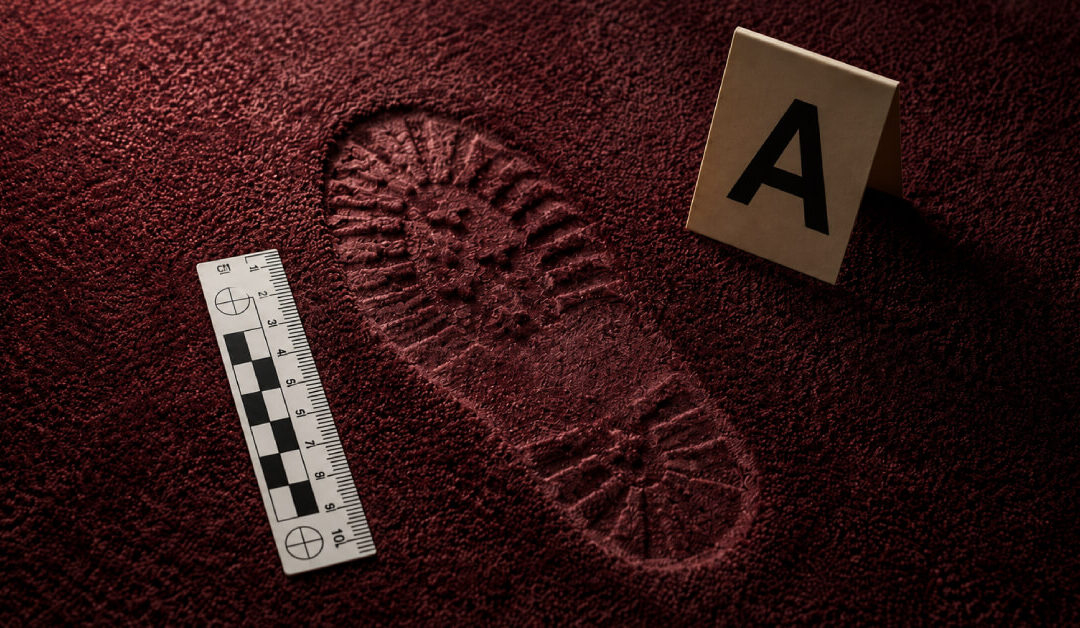
Ginzburg knew this, and had written it with a clarity that has not aged. “For thousands of years man was a hunter. During countless pursuits he learned to reconstruct the shapes and movements of invisible prey from tracks in the mud, broken branches, pellets of dung, tufts of hair, trapped feathers, stagnant smells. He learned to sniff out, record, interpret, and classify infinitesimal traces such as threads of saliva.” (Clues: Roots of an Evidential Paradigm, 1979). Written forty-seven years ago, this is still the most precise description of the technical crime-scene examination that I know.
Ginzburg began with three unlikely figures: Giovanni Morelli (1816–1891), a nineteenth-century physician and art historian; Sigmund Freud (1856–1939), the Viennese neurologist; Sherlock Holmes, a detective made of paper. Three figures who had never met and who worked in opposite fields, yet shared the same epistemological move: not to seek truth in obvious data, in dominant features, in signs already interpreted, but in neglected details, minimal variations, involuntary errors.

Morelli attributed ancient paintings not on the basis of composition or expression, where every painter knew how to make a good impression, but by the way the artist drew an earlobe, a fingernail, the fold of an ear. No one controlled those parts, and precisely for that reason they carried the true signature. Freud read slips of the tongue, dreams, parapraxes: not the declared plot of the narrative, but the knots where that plot tightened and allowed the repressed to appear. Holmes, for his part, did not look for a confession. He looked for the untrimmed nail, the marked cuff, the worn sleeve, the poorly cleaned shoe. He read the man in the details the man did not think he had to control.
The coincidence was not accidental. Ginzburg made it the core of his argument: there exists a way of knowing that does not begin from broad general laws, but from individual cases. It does not immediately seek a rule valid for everything; it observes a detail, connects it to other details, and tries to understand what has happened. It is an ancient, practical form of knowledge, born before laboratories and scientific manuals. It does not promise absolute certainty, but solid interpretations: conclusions that hold because the pieces, once placed together, begin to draw a figure.
The word Ginzburg uses for this method is a declared oxymoron: “the elastic rigour of the evidential paradigm appears unavoidable.” Elastic rigour means adapting to the unrepeatable nature of individual cases without thereby yielding to approximation. One cannot formalise the particular without losing it. Galilean sciences seek the universal law and sacrifice the individual in order to find it. The evidential paradigm does the opposite: it remains with the single case, accepts the margin, and still produces knowledge. A knowledge that proves nothing, but convinces you, and at the very least gives you a direction.
This type of knowledge has ancient roots: the hunter reading footprints in the snow, the sailor recognising the sky before a storm, the physician interpreting a face before making a diagnosis. None of them seeks a universal law in the modern sense of the term. Each looks for a single, unrepeatable trace which, if read properly, is more honest than many already ordered data.
In forensic science, this method is applied every day, often without naming it. It has many names: evidential reasoning, reconstruction, inference. One stops looking where everyone else is looking and begins to ask what does not add up: the inexplicable absence, the trace that should not have been there, the detail out of place. The technical vocabulary changes, not the gesture. And it is the same gesture as Morelli’s before a painted ear.
Something similar happens in writing about art. There too, it is useful to mistrust the initial impression, and the already known name against which one would like to lean the form: to see a work that wraps, covers, packages something and immediately conclude that the reference is Christo and Jeanne-Claude means stopping at the most convenient resemblance. Critical work begins afterwards, when that automatic response is suspended and one searches for what the work produces beyond its declared intention: the effect the artist had not foreseen, the one activated by the viewer’s gaze, or what the art system has left at the margins because it did not fit within the dominant frame. Duchamp called this the art coefficient: the inevitable distance between what the artist intended to do and what the work, once completed and seen, actually becomes.
The same is true on a crime scene. There too, the risk is to hand over too quickly what one sees to an explanation already prepared: a fall, a fight, a robbery. But it begins precisely there, when that first label is suspended. Before giving a name to the facts, one must let the arrangement of objects, the absences, the incongruities, the minor signs speak. Because often the scene does not say what it appears to say at first glance; it says it later, when one stops looking for confirmations and truly begins to observe.
Ginzburg was not an art critic. He was a historian who had understood how knowledge works in the concrete labour of those who handle documents, remains, traces left by others. For this reason he also spoke to those who do not write history: to anyone who tries to understand something starting from what remains, rather than from what is declared.
Now that he is dead, one paradox remains, and perhaps he would have appreciated it: we who learned from him to read traces now find ourselves having to read the trace he has left, and to understand where his work continues to act. A paradigm is not commemorated. There is one last trace to decipher now, and it is his: and like all traces, by itself it does not say where it leads. It waits for someone to crouch down and look at it.
This article was automatically translated from Italian. The original text reflects the author’s thoughts – please be
aware of potential linguistic differences in the translation.

The contents on this website are protected by a Creative Commons
license. 👈 Click on the image to learn more.